(
)
Inside MakeMyTrip’s AI Playbook: How Data, Emotion, and Automation Are Reshaping Travel Marketing
Discover how emotional storytelling, AI tools, and intent-driven content are reshaping travel marketing. Practical insights for founders, marketers, and AI-led teams from MakeMyTrip’s social media leadership.
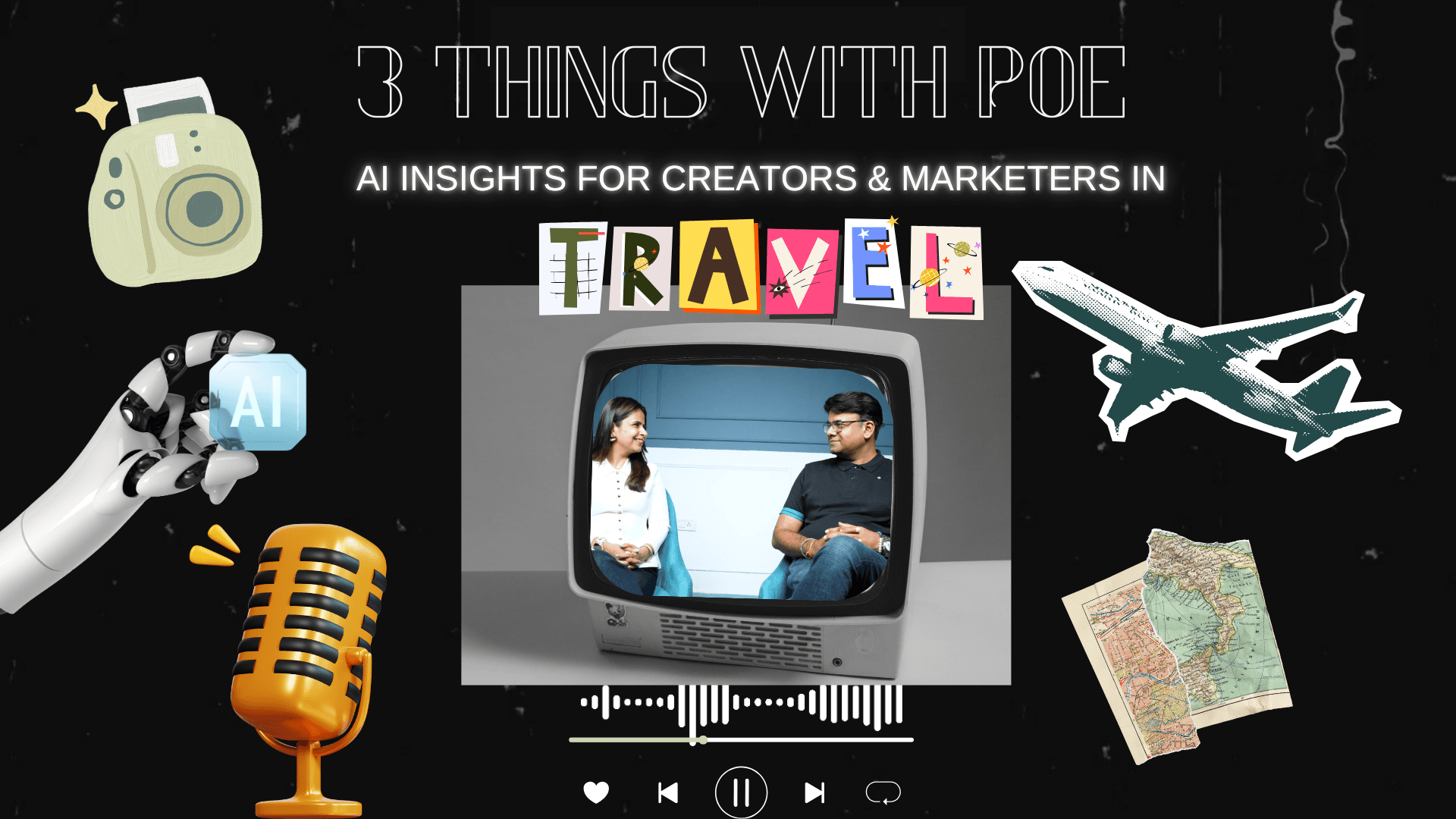
Insights from 3 Things with POE featuring Rohit Bhardwaj, MakeMyTrip
Travel content looks glamorous on the outside. Perfect visuals, exotic locations, flawless edits.
But the content that actually works is far less polished and far more intentional.
In this episode of 3 Things with POE, Rohit Bhardwaj, who leads social media and internal creative strategy at MakeMyTrip, breaks down what truly drives emotional connection, virality, and business impact in modern travel marketing.
This is not a trends list.
It is a practical playbook for founders, marketers, and AI-curious leaders building content systems that scale without losing soul.
1. How Do You Build Emotional Connection Without Chasing the Algorithm?
The biggest misconception in content marketing is treating algorithms as the audience.
Rohit reframes this sharply.
The algorithm deserves respect.
But the audience’s emotion decides virality.
Content that makes people laugh, pause, reflect, or feel seen will always outperform content designed only to “hack reach.”
Key Insight
Virality is not randomness.
It is clarity of intent.
At MakeMyTrip, successful content is built by knowing:
Who the content is for
Why it exists
What emotional response it is meant to trigger
They have integrated humour, storytelling, and product messaging in a way that feels natural, not forced. One example includes collaborating with leading stand-up comics, where the product appeared seamlessly inside the narrative rather than being announced as an ad.
The takeaway:
If your content feels like a billboard, people swipe away.
If it feels like a friend talking, people stay.
2. The Biggest Shifts in Travel Content Consumption Today
Travel audiences have changed, quietly but fundamentally.
Shift 1: Raw Beats Perfect
Audiences now trust a phone-shot reel more than a studio-polished ad. Background noise, imperfect framing, and real reactions outperform cinematic montages.
Shift 2: Moments Over Montages
Earlier, content focused on “10 reasons to visit Bali.”
Now, it is about “10 seconds when I finally felt calm.”
People are no longer collecting destinations. They are collecting moments.
Shift 3: Softer Signals Win
Loud calls to action are being replaced by subtle emotional cues. Stillness, honesty, and vulnerability are outperforming hype-driven storytelling.
What marketers should stop doing:
Overproducing at the cost of authenticity
Talking at the audience instead of with them
Chasing formats without understanding emotional intent
3. Creative and AI Tools That Actually Speed Up the Process
AI is no longer an experiment inside serious content teams. It is infrastructure.
Rohit breaks this down simply.
Tools in Play
ChatGPT as a fast, reliable copy partner
AI-powered video editing tools that understand short-form formats better than humans
Voiceover and cleaning tools that compress production cycles dramatically
The value is not just speed.
It is consistency.
AI allows teams to test, iterate, and refine content without burning out creative talent.
The real advantage:
AI handles execution.
Humans handle judgment.
4. How to Personalise Content for Different Types of Travellers
One-size-fits-all content no longer works.
At MakeMyTrip, personalisation starts with intent-based scripting.
Same Idea. Different Emotional Framing.
Business travellers: urgency, efficiency, time-saving
Solo travellers: experiences, discovery, self-expression
Families: comfort, safety, emotional reassurance
Tone shifts matter more than formats.
Rohit also highlights building emotional tone libraries, capturing variations like:
Excited explorer
Tired parent
Curious first-time traveller
This allows content to feel personal at scale without feeling manufactured.
5. What Metrics Actually Matter for Content Performance
Views are vanity.
Retention is truth.
Rohit focuses on three metrics that decide whether content passes the real-world test.
Retention: Are people staying?
Shareability: Are they sending it to someone else?
Saves: Are they coming back to it later?
If a piece of content is being saved, it has crossed from entertainment into value.
Only when these signals align does AI-powered optimisation truly make sense.
6. Where Should Small and Boutique Travel Brands Invest First?
Not in massive ad budgets.
Rohit’s priorities are clear.
Priority 1: Content Creation Tools
AI writing tools help small teams move faster without compromising quality.
Priority 2: Consumer Experience
AI chatbots, FAQs, and automated responses improve trust and responsiveness.
Priority 3: Analytics and Competitive Intelligence
AI helps decode performance and understand what competitors are doing without guesswork.
The message is simple:
Tools amplify clarity. They cannot replace it.
7. What Travel Influencers Need to Stop Doing Immediately
Some trends need to retire.
“Woke up like this in Santorini” scripts
Over-staged perfection
Being a walking billboard
Audiences crave behind-the-scenes honesty. They want to see creators engage in comments, reply to DMs, and show emotional context, not just aesthetic outcomes.
If your feed looks rented, people scroll past.
8. Personal AI Hacks for Travel Planning
Rohit’s own travel planning workflow is a masterclass in practical AI use.
Using AI search tools to generate itineraries based on family constraints
Feeding preferences into ChatGPT to structure day-wise plans
Managing budgets and time inside spreadsheets refined by AI
AI does not replace planning.
It removes friction from it.
9. The AI Frontiers That Will Redefine Travel Marketing
Three shifts will define the next phase.
1. Real-Time Personalisation at Scale
Every user will see a different website, ad, or app experience based on intent, mood, and behaviour.
2. Generative Interfaces
Search will evolve into scrollable, dynamic documents with reels, maps, budgets, and itineraries generated instantly.
3. AI Clones and Digital Twins
From voice to personality, digital twins will demo products and experiences. But with this power comes responsibility.
The future creator is not replaced by AI.
They collaborate with it, like musicians jamming together.
10. Belief Systems That Keep Leaders Ahead
Rohit closes with principles that extend beyond content.
Make clear decisions, even if imperfect
Do not overthink ideas that never ship
Trust pattern recognition, not just data
Choose depth over dopamine
In a distracted world, meaningful creation is a strategic advantage.
Final Thought
Modern travel marketing is no longer about selling destinations.
It is about understanding people.
At Pursuit of Extraordinary, we work with founders, brands, and teams navigating exactly this shift, where AI, creativity, and human insight intersect. If you are building content, campaigns, or platforms for a world that values relevance over noise, this is the moment to rethink how your systems are designed.
More News
Explore insights, tips, and trends to elevate your brand.


(
)
Inside MakeMyTrip’s AI Playbook: How Data, Emotion, and Automation Are Reshaping Travel Marketing
Discover how emotional storytelling, AI tools, and intent-driven content are reshaping travel marketing. Practical insights for founders, marketers, and AI-led teams from MakeMyTrip’s social media leadership.
Insights from 3 Things with POE featuring Rohit Bhardwaj, MakeMyTrip
Travel content looks glamorous on the outside. Perfect visuals, exotic locations, flawless edits.
But the content that actually works is far less polished and far more intentional.
In this episode of 3 Things with POE, Rohit Bhardwaj, who leads social media and internal creative strategy at MakeMyTrip, breaks down what truly drives emotional connection, virality, and business impact in modern travel marketing.
This is not a trends list.
It is a practical playbook for founders, marketers, and AI-curious leaders building content systems that scale without losing soul.
1. How Do You Build Emotional Connection Without Chasing the Algorithm?
The biggest misconception in content marketing is treating algorithms as the audience.
Rohit reframes this sharply.
The algorithm deserves respect.
But the audience’s emotion decides virality.
Content that makes people laugh, pause, reflect, or feel seen will always outperform content designed only to “hack reach.”
Key Insight
Virality is not randomness.
It is clarity of intent.
At MakeMyTrip, successful content is built by knowing:
Who the content is for
Why it exists
What emotional response it is meant to trigger
They have integrated humour, storytelling, and product messaging in a way that feels natural, not forced. One example includes collaborating with leading stand-up comics, where the product appeared seamlessly inside the narrative rather than being announced as an ad.
The takeaway:
If your content feels like a billboard, people swipe away.
If it feels like a friend talking, people stay.
2. The Biggest Shifts in Travel Content Consumption Today
Travel audiences have changed, quietly but fundamentally.
Shift 1: Raw Beats Perfect
Audiences now trust a phone-shot reel more than a studio-polished ad. Background noise, imperfect framing, and real reactions outperform cinematic montages.
Shift 2: Moments Over Montages
Earlier, content focused on “10 reasons to visit Bali.”
Now, it is about “10 seconds when I finally felt calm.”
People are no longer collecting destinations. They are collecting moments.
Shift 3: Softer Signals Win
Loud calls to action are being replaced by subtle emotional cues. Stillness, honesty, and vulnerability are outperforming hype-driven storytelling.
What marketers should stop doing:
Overproducing at the cost of authenticity
Talking at the audience instead of with them
Chasing formats without understanding emotional intent
3. Creative and AI Tools That Actually Speed Up the Process
AI is no longer an experiment inside serious content teams. It is infrastructure.
Rohit breaks this down simply.
Tools in Play
ChatGPT as a fast, reliable copy partner
AI-powered video editing tools that understand short-form formats better than humans
Voiceover and cleaning tools that compress production cycles dramatically
The value is not just speed.
It is consistency.
AI allows teams to test, iterate, and refine content without burning out creative talent.
The real advantage:
AI handles execution.
Humans handle judgment.
4. How to Personalise Content for Different Types of Travellers
One-size-fits-all content no longer works.
At MakeMyTrip, personalisation starts with intent-based scripting.
Same Idea. Different Emotional Framing.
Business travellers: urgency, efficiency, time-saving
Solo travellers: experiences, discovery, self-expression
Families: comfort, safety, emotional reassurance
Tone shifts matter more than formats.
Rohit also highlights building emotional tone libraries, capturing variations like:
Excited explorer
Tired parent
Curious first-time traveller
This allows content to feel personal at scale without feeling manufactured.
5. What Metrics Actually Matter for Content Performance
Views are vanity.
Retention is truth.
Rohit focuses on three metrics that decide whether content passes the real-world test.
Retention: Are people staying?
Shareability: Are they sending it to someone else?
Saves: Are they coming back to it later?
If a piece of content is being saved, it has crossed from entertainment into value.
Only when these signals align does AI-powered optimisation truly make sense.
6. Where Should Small and Boutique Travel Brands Invest First?
Not in massive ad budgets.
Rohit’s priorities are clear.
Priority 1: Content Creation Tools
AI writing tools help small teams move faster without compromising quality.
Priority 2: Consumer Experience
AI chatbots, FAQs, and automated responses improve trust and responsiveness.
Priority 3: Analytics and Competitive Intelligence
AI helps decode performance and understand what competitors are doing without guesswork.
The message is simple:
Tools amplify clarity. They cannot replace it.
7. What Travel Influencers Need to Stop Doing Immediately
Some trends need to retire.
“Woke up like this in Santorini” scripts
Over-staged perfection
Being a walking billboard
Audiences crave behind-the-scenes honesty. They want to see creators engage in comments, reply to DMs, and show emotional context, not just aesthetic outcomes.
If your feed looks rented, people scroll past.
8. Personal AI Hacks for Travel Planning
Rohit’s own travel planning workflow is a masterclass in practical AI use.
Using AI search tools to generate itineraries based on family constraints
Feeding preferences into ChatGPT to structure day-wise plans
Managing budgets and time inside spreadsheets refined by AI
AI does not replace planning.
It removes friction from it.
9. The AI Frontiers That Will Redefine Travel Marketing
Three shifts will define the next phase.
1. Real-Time Personalisation at Scale
Every user will see a different website, ad, or app experience based on intent, mood, and behaviour.
2. Generative Interfaces
Search will evolve into scrollable, dynamic documents with reels, maps, budgets, and itineraries generated instantly.
3. AI Clones and Digital Twins
From voice to personality, digital twins will demo products and experiences. But with this power comes responsibility.
The future creator is not replaced by AI.
They collaborate with it, like musicians jamming together.
10. Belief Systems That Keep Leaders Ahead
Rohit closes with principles that extend beyond content.
Make clear decisions, even if imperfect
Do not overthink ideas that never ship
Trust pattern recognition, not just data
Choose depth over dopamine
In a distracted world, meaningful creation is a strategic advantage.
Final Thought
Modern travel marketing is no longer about selling destinations.
It is about understanding people.
At Pursuit of Extraordinary, we work with founders, brands, and teams navigating exactly this shift, where AI, creativity, and human insight intersect. If you are building content, campaigns, or platforms for a world that values relevance over noise, this is the moment to rethink how your systems are designed.
More News
Explore insights, tips, and trends to elevate your brand.
(
)
Inside MakeMyTrip’s AI Playbook: How Data, Emotion, and Automation Are Reshaping Travel Marketing
Discover how emotional storytelling, AI tools, and intent-driven content are reshaping travel marketing. Practical insights for founders, marketers, and AI-led teams from MakeMyTrip’s social media leadership.
Insights from 3 Things with POE featuring Rohit Bhardwaj, MakeMyTrip
Travel content looks glamorous on the outside. Perfect visuals, exotic locations, flawless edits.
But the content that actually works is far less polished and far more intentional.
In this episode of 3 Things with POE, Rohit Bhardwaj, who leads social media and internal creative strategy at MakeMyTrip, breaks down what truly drives emotional connection, virality, and business impact in modern travel marketing.
This is not a trends list.
It is a practical playbook for founders, marketers, and AI-curious leaders building content systems that scale without losing soul.
1. How Do You Build Emotional Connection Without Chasing the Algorithm?
The biggest misconception in content marketing is treating algorithms as the audience.
Rohit reframes this sharply.
The algorithm deserves respect.
But the audience’s emotion decides virality.
Content that makes people laugh, pause, reflect, or feel seen will always outperform content designed only to “hack reach.”
Key Insight
Virality is not randomness.
It is clarity of intent.
At MakeMyTrip, successful content is built by knowing:
Who the content is for
Why it exists
What emotional response it is meant to trigger
They have integrated humour, storytelling, and product messaging in a way that feels natural, not forced. One example includes collaborating with leading stand-up comics, where the product appeared seamlessly inside the narrative rather than being announced as an ad.
The takeaway:
If your content feels like a billboard, people swipe away.
If it feels like a friend talking, people stay.
2. The Biggest Shifts in Travel Content Consumption Today
Travel audiences have changed, quietly but fundamentally.
Shift 1: Raw Beats Perfect
Audiences now trust a phone-shot reel more than a studio-polished ad. Background noise, imperfect framing, and real reactions outperform cinematic montages.
Shift 2: Moments Over Montages
Earlier, content focused on “10 reasons to visit Bali.”
Now, it is about “10 seconds when I finally felt calm.”
People are no longer collecting destinations. They are collecting moments.
Shift 3: Softer Signals Win
Loud calls to action are being replaced by subtle emotional cues. Stillness, honesty, and vulnerability are outperforming hype-driven storytelling.
What marketers should stop doing:
Overproducing at the cost of authenticity
Talking at the audience instead of with them
Chasing formats without understanding emotional intent
3. Creative and AI Tools That Actually Speed Up the Process
AI is no longer an experiment inside serious content teams. It is infrastructure.
Rohit breaks this down simply.
Tools in Play
ChatGPT as a fast, reliable copy partner
AI-powered video editing tools that understand short-form formats better than humans
Voiceover and cleaning tools that compress production cycles dramatically
The value is not just speed.
It is consistency.
AI allows teams to test, iterate, and refine content without burning out creative talent.
The real advantage:
AI handles execution.
Humans handle judgment.
4. How to Personalise Content for Different Types of Travellers
One-size-fits-all content no longer works.
At MakeMyTrip, personalisation starts with intent-based scripting.
Same Idea. Different Emotional Framing.
Business travellers: urgency, efficiency, time-saving
Solo travellers: experiences, discovery, self-expression
Families: comfort, safety, emotional reassurance
Tone shifts matter more than formats.
Rohit also highlights building emotional tone libraries, capturing variations like:
Excited explorer
Tired parent
Curious first-time traveller
This allows content to feel personal at scale without feeling manufactured.
5. What Metrics Actually Matter for Content Performance
Views are vanity.
Retention is truth.
Rohit focuses on three metrics that decide whether content passes the real-world test.
Retention: Are people staying?
Shareability: Are they sending it to someone else?
Saves: Are they coming back to it later?
If a piece of content is being saved, it has crossed from entertainment into value.
Only when these signals align does AI-powered optimisation truly make sense.
6. Where Should Small and Boutique Travel Brands Invest First?
Not in massive ad budgets.
Rohit’s priorities are clear.
Priority 1: Content Creation Tools
AI writing tools help small teams move faster without compromising quality.
Priority 2: Consumer Experience
AI chatbots, FAQs, and automated responses improve trust and responsiveness.
Priority 3: Analytics and Competitive Intelligence
AI helps decode performance and understand what competitors are doing without guesswork.
The message is simple:
Tools amplify clarity. They cannot replace it.
7. What Travel Influencers Need to Stop Doing Immediately
Some trends need to retire.
“Woke up like this in Santorini” scripts
Over-staged perfection
Being a walking billboard
Audiences crave behind-the-scenes honesty. They want to see creators engage in comments, reply to DMs, and show emotional context, not just aesthetic outcomes.
If your feed looks rented, people scroll past.
8. Personal AI Hacks for Travel Planning
Rohit’s own travel planning workflow is a masterclass in practical AI use.
Using AI search tools to generate itineraries based on family constraints
Feeding preferences into ChatGPT to structure day-wise plans
Managing budgets and time inside spreadsheets refined by AI
AI does not replace planning.
It removes friction from it.
9. The AI Frontiers That Will Redefine Travel Marketing
Three shifts will define the next phase.
1. Real-Time Personalisation at Scale
Every user will see a different website, ad, or app experience based on intent, mood, and behaviour.
2. Generative Interfaces
Search will evolve into scrollable, dynamic documents with reels, maps, budgets, and itineraries generated instantly.
3. AI Clones and Digital Twins
From voice to personality, digital twins will demo products and experiences. But with this power comes responsibility.
The future creator is not replaced by AI.
They collaborate with it, like musicians jamming together.
10. Belief Systems That Keep Leaders Ahead
Rohit closes with principles that extend beyond content.
Make clear decisions, even if imperfect
Do not overthink ideas that never ship
Trust pattern recognition, not just data
Choose depth over dopamine
In a distracted world, meaningful creation is a strategic advantage.
Final Thought
Modern travel marketing is no longer about selling destinations.
It is about understanding people.
At Pursuit of Extraordinary, we work with founders, brands, and teams navigating exactly this shift, where AI, creativity, and human insight intersect. If you are building content, campaigns, or platforms for a world that values relevance over noise, this is the moment to rethink how your systems are designed.
More News
Explore insights, tips, and trends to elevate your brand.