(
)
AI Beyond the Hype: What Actually Matters for Builders, Creators, and Leaders in 2025
A deep dive into real-world AI strategy, content creation, and product thinking with Cactus Communications CTO Nishchay Shah. Essential reading for founders, marketers, and AI-curious leaders.
Everyone is talking about artificial intelligence.
Very few are building it to solve something real.
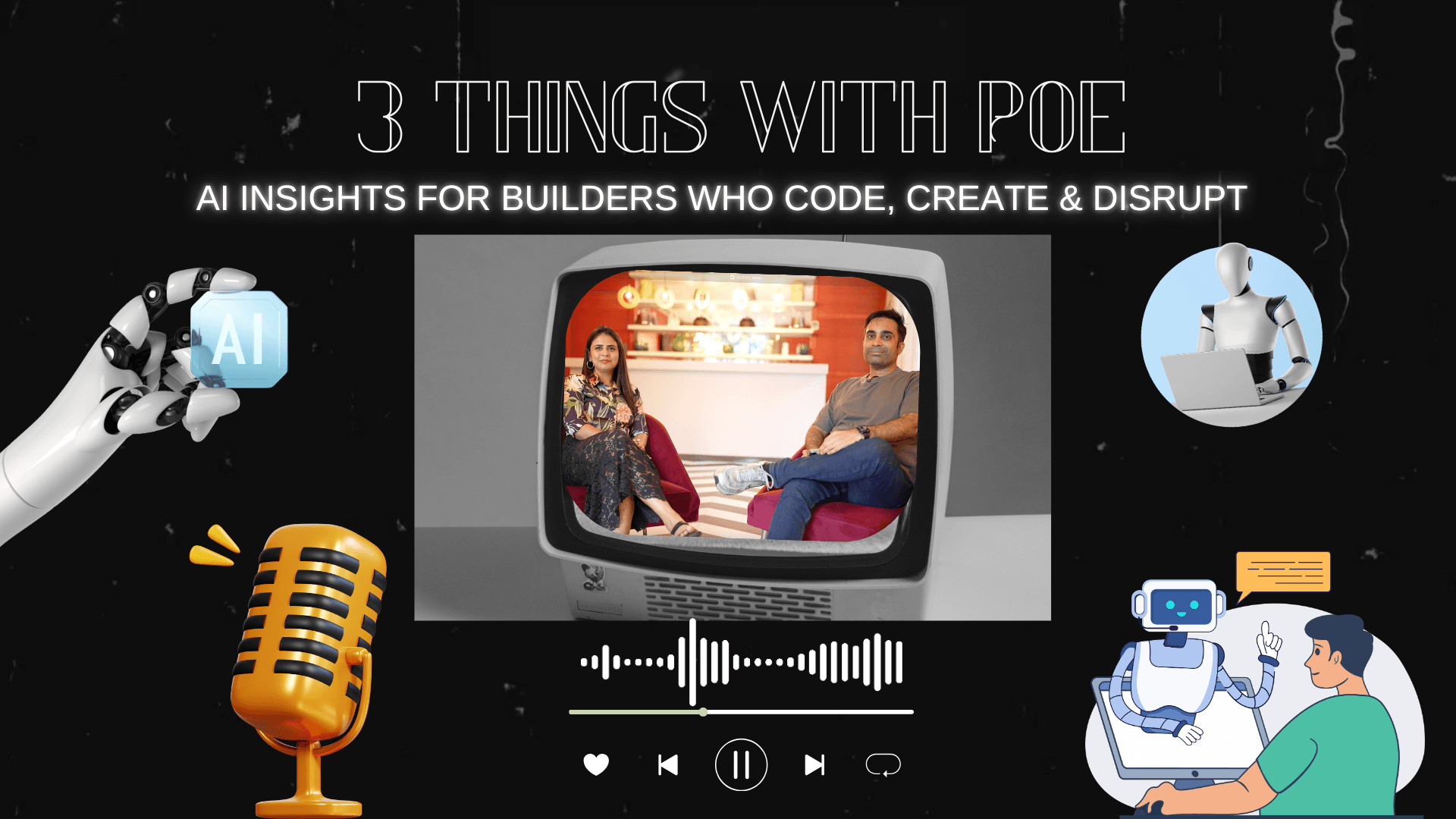
In this episode of 3 Things with POE, we sat down with Nishchay Shah, Chief Technology Officer at Cactus Communications, one of India’s leading AI-driven knowledge and research companies.
Nishchay has spent years building AI systems for researchers, scientists, and institutions long before AI became mainstream. What followed was a grounded, no-noise conversation on what AI is, what it is not, and where real value is being created.
This is not a trends list.
This is a reality check.
1. Three AI Trends Everyone Is Hyping, But Most Are Misunderstanding
❓ Will AI Replace Humans?
One of the most persistent narratives around AI is replacement. Nishchay calls this framing fundamentally flawed.
AI is not replacing humans at scale. It is augmenting human capability, especially in complex, cognitive workflows. The real shift is not job loss, but job redesign.
The winners will be those who learn to work with AI, not fear it.
❓ Bigger Models Automatically Mean Better AI
There is an ongoing arms race between Big Tech players to build ever-larger models. But size alone is not the future.
Nishchay points to emerging research showing that narrow, domain-specific models often outperform massive general-purpose models when applied to real-world workflows.
An architect, researcher, or editor does not need a model trained on everything. They need one trained deeply on their domain, augmented selectively by a larger model when required.
❓ Artificial General Intelligence Is Around the Corner
AGI is often portrayed as imminent and existential. Nishchay brings this back to reality.
True AGI, systems that can learn, evolve, and self-correct autonomously, is far more complex than headlines suggest. The leap from today’s models to AGI is not incremental. It is structural.
AGI is not “next year’s update”. It is a long-term evolution.
2. Three Underrated AI Use Cases in Content Creation
AI in content creation is still being used shallowly. Nishchay highlights three areas where it quietly delivers disproportionate value.
1️⃣ Content Reuse and Multi-Format Extraction
AI enables long-form content to be repurposed into byte-sized assets, summaries, multimedia formats, and cross-platform adaptations without manual effort.
This is not about writing more. It is about extracting more value from what already exists.
2️⃣ AI as a Brainstorming Sidekick
There is hesitation around using AI for ideation. Nishchay reframes this.
AI works best when it is fed your thinking, data, and constraints. Used correctly, it becomes a sparring partner, not a replacement.
The creative still leads. AI accelerates.
3️⃣ Style Replication at Scale
Generic AI output is a known problem. Cactus is solving this by training models to replicate specific writing and communication styles, enabling consistency across large volumes of content.
This is critical for brands, publishers, and institutions where voice matters.
3. How Cactus’ AI Products Are Transforming Academic Research
Cactus is applying AI where stakes are high: research, credibility, and knowledge integrity.
🔹 Paperpal
An end-to-end AI ecosystem for researchers to brainstorm, write, collaborate, and prepare work for publication.
🔹 Mind the Graph
A tool that converts dense academic text into infographics, visual abstracts, and presentations, making research easier to understand and share.
🔹 Discovery Platform
With nearly 5 million research papers published every year, relevance is the real challenge.
This AI learns a researcher’s background, interests, and behaviour to surface what actually matters to them, not what is merely new.
4. Three AI Breakthroughs Cactus Built Before ChatGPT Made AI Popular
Long before generative AI entered the spotlight, Cactus had already built:
✔ Grammar Error Correction Models
Trained on over 25 years of editorial expertise, focused on improving how people write, not just generating text.
✔ Research Integrity Systems
AI tools designed to detect fraud, misconduct, and anomalies in academic publishing, where ethics are non-negotiable.
✔ Advanced Document Parsers
Systems capable of understanding and extracting data from complex documents, enabling multiple downstream AI applications.
5. AI Breakthroughs That Stood Out in the Last Year
According to Nishchay, three developments matter most:
AI in medicine, especially drug and protein discovery
Large context windows, enabling models to understand deeper, longer narratives
Agentic AI and model context protocols, allowing multiple AI systems to work together as coordinated agents
This is where AI shifts from tools to systems.
6. The Biggest Mistakes Companies Make When Adopting AI
❌ Shiny Object Syndrome
AI does not magically deliver overnight efficiency. Without clear use cases, it becomes expensive theatre.
❌ Lack of Training
Most organisations fail not because of AI, but because teams are never taught how to use it effectively.
❌ Ignoring Ethics in High-Stakes Domains
In areas like healthcare, law, and research, AI must operate within strict ethical frameworks. Out-of-the-box models are not enough.
7. Career Advice for the Next Generation of AI Builders
Nishchay’s advice is refreshingly grounded.
You do not need a four-year degree to start working with AI
Start early, even at school level
Go deep into how AI actually works, including its limitations
In a world where tools become standardised, orchestration and understanding will define leadership.
Why This Conversation Matters
This episode is not about chasing AI trends.
It is about building AI systems that create real impact, whether in content, research, marketing, or product strategy.
For founders, marketers, and leaders, the message is clear:
AI success does not come from adopting everything.
It comes from choosing wisely, training deeply, and integrating ethically.
At Pursuit of Extraordinary, we help organisations cut through AI noise and design AI-powered marketing, storytelling, and content systems that are practical, scalable, and aligned with business reality.
If you are exploring how AI can meaningfully transform your brand, product narrative, or marketing engine, reach out to us at hello@pursuitofextraordinary.com or visit www.pursuitofextraordinary.com.
More News
Explore insights, tips, and trends to elevate your brand.


(
)
AI Beyond the Hype: What Actually Matters for Builders, Creators, and Leaders in 2025
A deep dive into real-world AI strategy, content creation, and product thinking with Cactus Communications CTO Nishchay Shah. Essential reading for founders, marketers, and AI-curious leaders.
Everyone is talking about artificial intelligence.
Very few are building it to solve something real.
In this episode of 3 Things with POE, we sat down with Nishchay Shah, Chief Technology Officer at Cactus Communications, one of India’s leading AI-driven knowledge and research companies.
Nishchay has spent years building AI systems for researchers, scientists, and institutions long before AI became mainstream. What followed was a grounded, no-noise conversation on what AI is, what it is not, and where real value is being created.
This is not a trends list.
This is a reality check.
1. Three AI Trends Everyone Is Hyping, But Most Are Misunderstanding
❓ Will AI Replace Humans?
One of the most persistent narratives around AI is replacement. Nishchay calls this framing fundamentally flawed.
AI is not replacing humans at scale. It is augmenting human capability, especially in complex, cognitive workflows. The real shift is not job loss, but job redesign.
The winners will be those who learn to work with AI, not fear it.
❓ Bigger Models Automatically Mean Better AI
There is an ongoing arms race between Big Tech players to build ever-larger models. But size alone is not the future.
Nishchay points to emerging research showing that narrow, domain-specific models often outperform massive general-purpose models when applied to real-world workflows.
An architect, researcher, or editor does not need a model trained on everything. They need one trained deeply on their domain, augmented selectively by a larger model when required.
❓ Artificial General Intelligence Is Around the Corner
AGI is often portrayed as imminent and existential. Nishchay brings this back to reality.
True AGI, systems that can learn, evolve, and self-correct autonomously, is far more complex than headlines suggest. The leap from today’s models to AGI is not incremental. It is structural.
AGI is not “next year’s update”. It is a long-term evolution.
2. Three Underrated AI Use Cases in Content Creation
AI in content creation is still being used shallowly. Nishchay highlights three areas where it quietly delivers disproportionate value.
1️⃣ Content Reuse and Multi-Format Extraction
AI enables long-form content to be repurposed into byte-sized assets, summaries, multimedia formats, and cross-platform adaptations without manual effort.
This is not about writing more. It is about extracting more value from what already exists.
2️⃣ AI as a Brainstorming Sidekick
There is hesitation around using AI for ideation. Nishchay reframes this.
AI works best when it is fed your thinking, data, and constraints. Used correctly, it becomes a sparring partner, not a replacement.
The creative still leads. AI accelerates.
3️⃣ Style Replication at Scale
Generic AI output is a known problem. Cactus is solving this by training models to replicate specific writing and communication styles, enabling consistency across large volumes of content.
This is critical for brands, publishers, and institutions where voice matters.
3. How Cactus’ AI Products Are Transforming Academic Research
Cactus is applying AI where stakes are high: research, credibility, and knowledge integrity.
🔹 Paperpal
An end-to-end AI ecosystem for researchers to brainstorm, write, collaborate, and prepare work for publication.
🔹 Mind the Graph
A tool that converts dense academic text into infographics, visual abstracts, and presentations, making research easier to understand and share.
🔹 Discovery Platform
With nearly 5 million research papers published every year, relevance is the real challenge.
This AI learns a researcher’s background, interests, and behaviour to surface what actually matters to them, not what is merely new.
4. Three AI Breakthroughs Cactus Built Before ChatGPT Made AI Popular
Long before generative AI entered the spotlight, Cactus had already built:
✔ Grammar Error Correction Models
Trained on over 25 years of editorial expertise, focused on improving how people write, not just generating text.
✔ Research Integrity Systems
AI tools designed to detect fraud, misconduct, and anomalies in academic publishing, where ethics are non-negotiable.
✔ Advanced Document Parsers
Systems capable of understanding and extracting data from complex documents, enabling multiple downstream AI applications.
5. AI Breakthroughs That Stood Out in the Last Year
According to Nishchay, three developments matter most:
AI in medicine, especially drug and protein discovery
Large context windows, enabling models to understand deeper, longer narratives
Agentic AI and model context protocols, allowing multiple AI systems to work together as coordinated agents
This is where AI shifts from tools to systems.
6. The Biggest Mistakes Companies Make When Adopting AI
❌ Shiny Object Syndrome
AI does not magically deliver overnight efficiency. Without clear use cases, it becomes expensive theatre.
❌ Lack of Training
Most organisations fail not because of AI, but because teams are never taught how to use it effectively.
❌ Ignoring Ethics in High-Stakes Domains
In areas like healthcare, law, and research, AI must operate within strict ethical frameworks. Out-of-the-box models are not enough.
7. Career Advice for the Next Generation of AI Builders
Nishchay’s advice is refreshingly grounded.
You do not need a four-year degree to start working with AI
Start early, even at school level
Go deep into how AI actually works, including its limitations
In a world where tools become standardised, orchestration and understanding will define leadership.
Why This Conversation Matters
This episode is not about chasing AI trends.
It is about building AI systems that create real impact, whether in content, research, marketing, or product strategy.
For founders, marketers, and leaders, the message is clear:
AI success does not come from adopting everything.
It comes from choosing wisely, training deeply, and integrating ethically.
At Pursuit of Extraordinary, we help organisations cut through AI noise and design AI-powered marketing, storytelling, and content systems that are practical, scalable, and aligned with business reality.
If you are exploring how AI can meaningfully transform your brand, product narrative, or marketing engine, reach out to us at hello@pursuitofextraordinary.com or visit www.pursuitofextraordinary.com.
More News
Explore insights, tips, and trends to elevate your brand.
(
)
AI Beyond the Hype: What Actually Matters for Builders, Creators, and Leaders in 2025
A deep dive into real-world AI strategy, content creation, and product thinking with Cactus Communications CTO Nishchay Shah. Essential reading for founders, marketers, and AI-curious leaders.
Everyone is talking about artificial intelligence.
Very few are building it to solve something real.
In this episode of 3 Things with POE, we sat down with Nishchay Shah, Chief Technology Officer at Cactus Communications, one of India’s leading AI-driven knowledge and research companies.
Nishchay has spent years building AI systems for researchers, scientists, and institutions long before AI became mainstream. What followed was a grounded, no-noise conversation on what AI is, what it is not, and where real value is being created.
This is not a trends list.
This is a reality check.
1. Three AI Trends Everyone Is Hyping, But Most Are Misunderstanding
❓ Will AI Replace Humans?
One of the most persistent narratives around AI is replacement. Nishchay calls this framing fundamentally flawed.
AI is not replacing humans at scale. It is augmenting human capability, especially in complex, cognitive workflows. The real shift is not job loss, but job redesign.
The winners will be those who learn to work with AI, not fear it.
❓ Bigger Models Automatically Mean Better AI
There is an ongoing arms race between Big Tech players to build ever-larger models. But size alone is not the future.
Nishchay points to emerging research showing that narrow, domain-specific models often outperform massive general-purpose models when applied to real-world workflows.
An architect, researcher, or editor does not need a model trained on everything. They need one trained deeply on their domain, augmented selectively by a larger model when required.
❓ Artificial General Intelligence Is Around the Corner
AGI is often portrayed as imminent and existential. Nishchay brings this back to reality.
True AGI, systems that can learn, evolve, and self-correct autonomously, is far more complex than headlines suggest. The leap from today’s models to AGI is not incremental. It is structural.
AGI is not “next year’s update”. It is a long-term evolution.
2. Three Underrated AI Use Cases in Content Creation
AI in content creation is still being used shallowly. Nishchay highlights three areas where it quietly delivers disproportionate value.
1️⃣ Content Reuse and Multi-Format Extraction
AI enables long-form content to be repurposed into byte-sized assets, summaries, multimedia formats, and cross-platform adaptations without manual effort.
This is not about writing more. It is about extracting more value from what already exists.
2️⃣ AI as a Brainstorming Sidekick
There is hesitation around using AI for ideation. Nishchay reframes this.
AI works best when it is fed your thinking, data, and constraints. Used correctly, it becomes a sparring partner, not a replacement.
The creative still leads. AI accelerates.
3️⃣ Style Replication at Scale
Generic AI output is a known problem. Cactus is solving this by training models to replicate specific writing and communication styles, enabling consistency across large volumes of content.
This is critical for brands, publishers, and institutions where voice matters.
3. How Cactus’ AI Products Are Transforming Academic Research
Cactus is applying AI where stakes are high: research, credibility, and knowledge integrity.
🔹 Paperpal
An end-to-end AI ecosystem for researchers to brainstorm, write, collaborate, and prepare work for publication.
🔹 Mind the Graph
A tool that converts dense academic text into infographics, visual abstracts, and presentations, making research easier to understand and share.
🔹 Discovery Platform
With nearly 5 million research papers published every year, relevance is the real challenge.
This AI learns a researcher’s background, interests, and behaviour to surface what actually matters to them, not what is merely new.
4. Three AI Breakthroughs Cactus Built Before ChatGPT Made AI Popular
Long before generative AI entered the spotlight, Cactus had already built:
✔ Grammar Error Correction Models
Trained on over 25 years of editorial expertise, focused on improving how people write, not just generating text.
✔ Research Integrity Systems
AI tools designed to detect fraud, misconduct, and anomalies in academic publishing, where ethics are non-negotiable.
✔ Advanced Document Parsers
Systems capable of understanding and extracting data from complex documents, enabling multiple downstream AI applications.
5. AI Breakthroughs That Stood Out in the Last Year
According to Nishchay, three developments matter most:
AI in medicine, especially drug and protein discovery
Large context windows, enabling models to understand deeper, longer narratives
Agentic AI and model context protocols, allowing multiple AI systems to work together as coordinated agents
This is where AI shifts from tools to systems.
6. The Biggest Mistakes Companies Make When Adopting AI
❌ Shiny Object Syndrome
AI does not magically deliver overnight efficiency. Without clear use cases, it becomes expensive theatre.
❌ Lack of Training
Most organisations fail not because of AI, but because teams are never taught how to use it effectively.
❌ Ignoring Ethics in High-Stakes Domains
In areas like healthcare, law, and research, AI must operate within strict ethical frameworks. Out-of-the-box models are not enough.
7. Career Advice for the Next Generation of AI Builders
Nishchay’s advice is refreshingly grounded.
You do not need a four-year degree to start working with AI
Start early, even at school level
Go deep into how AI actually works, including its limitations
In a world where tools become standardised, orchestration and understanding will define leadership.
Why This Conversation Matters
This episode is not about chasing AI trends.
It is about building AI systems that create real impact, whether in content, research, marketing, or product strategy.
For founders, marketers, and leaders, the message is clear:
AI success does not come from adopting everything.
It comes from choosing wisely, training deeply, and integrating ethically.
At Pursuit of Extraordinary, we help organisations cut through AI noise and design AI-powered marketing, storytelling, and content systems that are practical, scalable, and aligned with business reality.
If you are exploring how AI can meaningfully transform your brand, product narrative, or marketing engine, reach out to us at hello@pursuitofextraordinary.com or visit www.pursuitofextraordinary.com.
More News
Explore insights, tips, and trends to elevate your brand.