(
)
From Prompts to Products: 10 AI-Powered Websites You Can Build on Canva Code Without Writing a Single Line of Code
A quiet shift is underway in how founders, marketers, and creators think about building on the web. Coding is no longer the gatekeeper. Speed, clarity, and intent are.
Websites are no longer built.
They are prompted.
A quiet shift is underway in how founders, marketers, and creators think about building on the web. Coding is no longer the gatekeeper. Speed, clarity, and intent are.
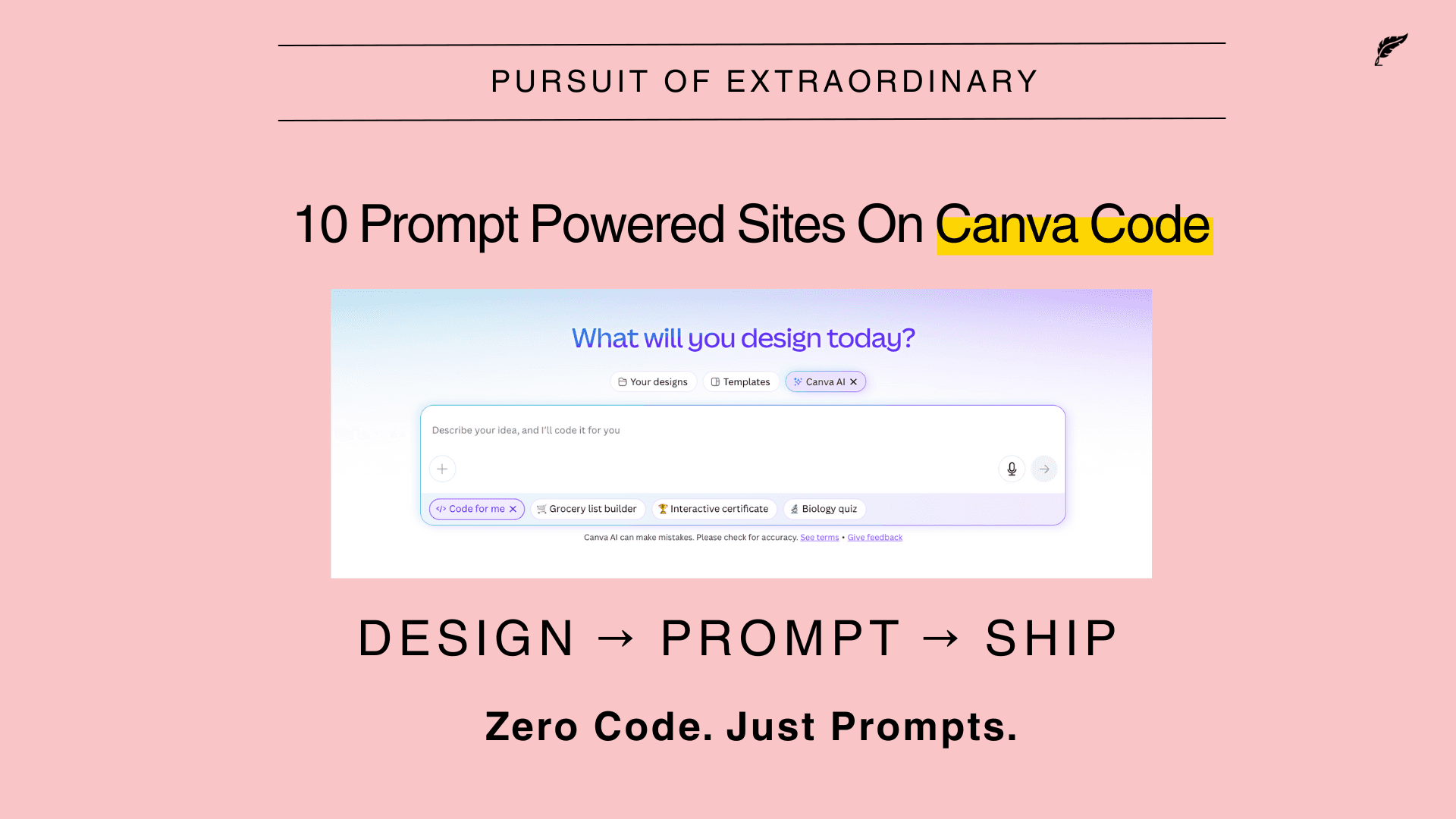
With Canva Code, the workflow has fundamentally changed:
Design → Prompt → Ship
No development sprints.
No technical bottlenecks.
Just structured prompts turning ideas into live, functional websites.
Below are 10 prompt-powered website formats you can now build on Canva Code, what each one is best used for, and how non-coders can leverage them strategically.
1. Personal Portfolio Website
Best for: Founders, consultants, designers, creators
This format replaces static resumes and cluttered portfolio pages with a clean, modern digital presence.
What the prompt builds
Full-screen hero section with name and positioning
“About Me” with bio and profile image
Projects section with expandable thumbnails
Contact form with name, email, and message
Minimal colour palette with a bold accent for CTAs
Why it works
It communicates credibility in seconds.
Not through volume, but through structure and restraint.
2. Real Estate Listing Page
Best for: Real estate brands, brokers, property platforms
Instead of bulky property PDFs, this prompt creates a high-conversion listing page.
What the prompt builds
Clean navigation and hero image of the featured property
Property cards with images, pricing, and location
Clear “Enquire Now” CTAs
Testimonial slider for social proof
Elegant neutral palette with earthy accents
Why it works
It moves real estate marketing from brochure mode to decision-support mode.
3. E-Commerce Product Catalogue
Best for: D2C brands, beauty, lifestyle, retail startups
This is not a full ecommerce backend. It is a fast, interactive product experience.
What the prompt builds
Category tabs such as Cleansers, Serums, Moisturizers
Product cards with images, pricing, and add-to-cart buttons
Floating cart icon with item count
Soft, premium visual styling
Why it works
Perfect for launches, MVPs, or showcasing collections before full-scale ecommerce investment.
4. Event Microsite for a Webinar
Best for: Marketers, educators, communities, SaaS teams
A single-page site built entirely around conversion.
What the prompt builds
Event banner with title and date
About the event section
Speaker lineup with photos and bios
Registration form
Dark theme with high-contrast CTA buttons
Why it works
It eliminates friction. One page, one goal, one action.
5. Gamified Learning Module
Best for: Climate tech, sustainability, education, HR teams
Learning does not have to feel like homework.
What the prompt builds
Drag-and-drop game interface
Matching terms with definitions
Real-time feedback for correct and incorrect answers
Progress bar and final score
Playful visuals with earthy tones
Why it works
Gamification increases retention, not just engagement.
6. Interactive Infographic
Best for: ESG, sustainability, research-driven brands
Static infographics struggle to hold attention. Interactive ones invite curiosity.
What the prompt builds
Visual flowchart with clickable stages
Expandable sections with text, images, and key stats
Clear narrative progression
Strong visual hierarchy
Why it works
Complex topics become explorable, not overwhelming.
7. Startup Pitch Deck (Web-Based)
Best for: Early-stage startups, investors, accelerators
Pitch decks no longer need to live as PDFs.
What the prompt builds
Horizontal slide navigation
Core slides: Problem, Solution, Market, Product Demo, Business Model, Team
Embedded video capability
Tech-forward visual theme
Why it works
It feels dynamic, modern, and far more engaging than email attachments.
8. Interactive Resume
Best for: Founders, senior professionals, consultants
This is a resume people actually explore.
What the prompt builds
Animated timeline layout
Expandable sections for education, work, skills, and projects
Downloadable PDF button
Clean monochrome palette with accent highlights
Why it works
It turns experience into a narrative, not a list.
9. AI Marketing Tool Explainer Page
Best for: SaaS founders, AI startups, product marketers
Explaining AI is harder than building it.
What the prompt builds
Horizontal scroll experience
Step-by-step flow: Data Input → AI Processing → Campaign Launch → Analytics
Icons, animations, and guided arrows
Bold typography with gradient backgrounds
Why it works
It demystifies AI without dumbing it down.
10. Restaurant Menu Microsite
Best for: Cafes, restaurants, hospitality brands
Menus should do more than list items.
What the prompt builds
Category tabs for meals and drinks
Item cards with photos, descriptions, and pricing
“Book a Table” CTA
Warm, rustic visual style with hand-drawn typography
Why it works
It blends storytelling with utility.
The Bigger Shift This Represents
What Canva Code enables is not just faster websites.
It enables:
Faster experimentation
Faster validation
Faster shipping
For founders and marketers, this changes the cost of trying ideas.
For teams, it removes dependency loops.
For creators, it restores momentum.
At Pursuit of Extraordinary, we spend a lot of time helping brands rethink how they build, communicate, and launch in an AI-first world. Tools like Canva Code are not shortcuts. They are leverage. The real advantage lies in knowing what to build, why to build it, and how to prompt with clarity.
More News
Explore insights, tips, and trends to elevate your brand.


(
)
From Prompts to Products: 10 AI-Powered Websites You Can Build on Canva Code Without Writing a Single Line of Code
A quiet shift is underway in how founders, marketers, and creators think about building on the web. Coding is no longer the gatekeeper. Speed, clarity, and intent are.
Websites are no longer built.
They are prompted.
A quiet shift is underway in how founders, marketers, and creators think about building on the web. Coding is no longer the gatekeeper. Speed, clarity, and intent are.
With Canva Code, the workflow has fundamentally changed:
Design → Prompt → Ship
No development sprints.
No technical bottlenecks.
Just structured prompts turning ideas into live, functional websites.
Below are 10 prompt-powered website formats you can now build on Canva Code, what each one is best used for, and how non-coders can leverage them strategically.
1. Personal Portfolio Website
Best for: Founders, consultants, designers, creators
This format replaces static resumes and cluttered portfolio pages with a clean, modern digital presence.
What the prompt builds
Full-screen hero section with name and positioning
“About Me” with bio and profile image
Projects section with expandable thumbnails
Contact form with name, email, and message
Minimal colour palette with a bold accent for CTAs
Why it works
It communicates credibility in seconds.
Not through volume, but through structure and restraint.
2. Real Estate Listing Page
Best for: Real estate brands, brokers, property platforms
Instead of bulky property PDFs, this prompt creates a high-conversion listing page.
What the prompt builds
Clean navigation and hero image of the featured property
Property cards with images, pricing, and location
Clear “Enquire Now” CTAs
Testimonial slider for social proof
Elegant neutral palette with earthy accents
Why it works
It moves real estate marketing from brochure mode to decision-support mode.
3. E-Commerce Product Catalogue
Best for: D2C brands, beauty, lifestyle, retail startups
This is not a full ecommerce backend. It is a fast, interactive product experience.
What the prompt builds
Category tabs such as Cleansers, Serums, Moisturizers
Product cards with images, pricing, and add-to-cart buttons
Floating cart icon with item count
Soft, premium visual styling
Why it works
Perfect for launches, MVPs, or showcasing collections before full-scale ecommerce investment.
4. Event Microsite for a Webinar
Best for: Marketers, educators, communities, SaaS teams
A single-page site built entirely around conversion.
What the prompt builds
Event banner with title and date
About the event section
Speaker lineup with photos and bios
Registration form
Dark theme with high-contrast CTA buttons
Why it works
It eliminates friction. One page, one goal, one action.
5. Gamified Learning Module
Best for: Climate tech, sustainability, education, HR teams
Learning does not have to feel like homework.
What the prompt builds
Drag-and-drop game interface
Matching terms with definitions
Real-time feedback for correct and incorrect answers
Progress bar and final score
Playful visuals with earthy tones
Why it works
Gamification increases retention, not just engagement.
6. Interactive Infographic
Best for: ESG, sustainability, research-driven brands
Static infographics struggle to hold attention. Interactive ones invite curiosity.
What the prompt builds
Visual flowchart with clickable stages
Expandable sections with text, images, and key stats
Clear narrative progression
Strong visual hierarchy
Why it works
Complex topics become explorable, not overwhelming.
7. Startup Pitch Deck (Web-Based)
Best for: Early-stage startups, investors, accelerators
Pitch decks no longer need to live as PDFs.
What the prompt builds
Horizontal slide navigation
Core slides: Problem, Solution, Market, Product Demo, Business Model, Team
Embedded video capability
Tech-forward visual theme
Why it works
It feels dynamic, modern, and far more engaging than email attachments.
8. Interactive Resume
Best for: Founders, senior professionals, consultants
This is a resume people actually explore.
What the prompt builds
Animated timeline layout
Expandable sections for education, work, skills, and projects
Downloadable PDF button
Clean monochrome palette with accent highlights
Why it works
It turns experience into a narrative, not a list.
9. AI Marketing Tool Explainer Page
Best for: SaaS founders, AI startups, product marketers
Explaining AI is harder than building it.
What the prompt builds
Horizontal scroll experience
Step-by-step flow: Data Input → AI Processing → Campaign Launch → Analytics
Icons, animations, and guided arrows
Bold typography with gradient backgrounds
Why it works
It demystifies AI without dumbing it down.
10. Restaurant Menu Microsite
Best for: Cafes, restaurants, hospitality brands
Menus should do more than list items.
What the prompt builds
Category tabs for meals and drinks
Item cards with photos, descriptions, and pricing
“Book a Table” CTA
Warm, rustic visual style with hand-drawn typography
Why it works
It blends storytelling with utility.
The Bigger Shift This Represents
What Canva Code enables is not just faster websites.
It enables:
Faster experimentation
Faster validation
Faster shipping
For founders and marketers, this changes the cost of trying ideas.
For teams, it removes dependency loops.
For creators, it restores momentum.
At Pursuit of Extraordinary, we spend a lot of time helping brands rethink how they build, communicate, and launch in an AI-first world. Tools like Canva Code are not shortcuts. They are leverage. The real advantage lies in knowing what to build, why to build it, and how to prompt with clarity.
More News
Explore insights, tips, and trends to elevate your brand.
(
)
From Prompts to Products: 10 AI-Powered Websites You Can Build on Canva Code Without Writing a Single Line of Code
A quiet shift is underway in how founders, marketers, and creators think about building on the web. Coding is no longer the gatekeeper. Speed, clarity, and intent are.
Websites are no longer built.
They are prompted.
A quiet shift is underway in how founders, marketers, and creators think about building on the web. Coding is no longer the gatekeeper. Speed, clarity, and intent are.
With Canva Code, the workflow has fundamentally changed:
Design → Prompt → Ship
No development sprints.
No technical bottlenecks.
Just structured prompts turning ideas into live, functional websites.
Below are 10 prompt-powered website formats you can now build on Canva Code, what each one is best used for, and how non-coders can leverage them strategically.
1. Personal Portfolio Website
Best for: Founders, consultants, designers, creators
This format replaces static resumes and cluttered portfolio pages with a clean, modern digital presence.
What the prompt builds
Full-screen hero section with name and positioning
“About Me” with bio and profile image
Projects section with expandable thumbnails
Contact form with name, email, and message
Minimal colour palette with a bold accent for CTAs
Why it works
It communicates credibility in seconds.
Not through volume, but through structure and restraint.
2. Real Estate Listing Page
Best for: Real estate brands, brokers, property platforms
Instead of bulky property PDFs, this prompt creates a high-conversion listing page.
What the prompt builds
Clean navigation and hero image of the featured property
Property cards with images, pricing, and location
Clear “Enquire Now” CTAs
Testimonial slider for social proof
Elegant neutral palette with earthy accents
Why it works
It moves real estate marketing from brochure mode to decision-support mode.
3. E-Commerce Product Catalogue
Best for: D2C brands, beauty, lifestyle, retail startups
This is not a full ecommerce backend. It is a fast, interactive product experience.
What the prompt builds
Category tabs such as Cleansers, Serums, Moisturizers
Product cards with images, pricing, and add-to-cart buttons
Floating cart icon with item count
Soft, premium visual styling
Why it works
Perfect for launches, MVPs, or showcasing collections before full-scale ecommerce investment.
4. Event Microsite for a Webinar
Best for: Marketers, educators, communities, SaaS teams
A single-page site built entirely around conversion.
What the prompt builds
Event banner with title and date
About the event section
Speaker lineup with photos and bios
Registration form
Dark theme with high-contrast CTA buttons
Why it works
It eliminates friction. One page, one goal, one action.
5. Gamified Learning Module
Best for: Climate tech, sustainability, education, HR teams
Learning does not have to feel like homework.
What the prompt builds
Drag-and-drop game interface
Matching terms with definitions
Real-time feedback for correct and incorrect answers
Progress bar and final score
Playful visuals with earthy tones
Why it works
Gamification increases retention, not just engagement.
6. Interactive Infographic
Best for: ESG, sustainability, research-driven brands
Static infographics struggle to hold attention. Interactive ones invite curiosity.
What the prompt builds
Visual flowchart with clickable stages
Expandable sections with text, images, and key stats
Clear narrative progression
Strong visual hierarchy
Why it works
Complex topics become explorable, not overwhelming.
7. Startup Pitch Deck (Web-Based)
Best for: Early-stage startups, investors, accelerators
Pitch decks no longer need to live as PDFs.
What the prompt builds
Horizontal slide navigation
Core slides: Problem, Solution, Market, Product Demo, Business Model, Team
Embedded video capability
Tech-forward visual theme
Why it works
It feels dynamic, modern, and far more engaging than email attachments.
8. Interactive Resume
Best for: Founders, senior professionals, consultants
This is a resume people actually explore.
What the prompt builds
Animated timeline layout
Expandable sections for education, work, skills, and projects
Downloadable PDF button
Clean monochrome palette with accent highlights
Why it works
It turns experience into a narrative, not a list.
9. AI Marketing Tool Explainer Page
Best for: SaaS founders, AI startups, product marketers
Explaining AI is harder than building it.
What the prompt builds
Horizontal scroll experience
Step-by-step flow: Data Input → AI Processing → Campaign Launch → Analytics
Icons, animations, and guided arrows
Bold typography with gradient backgrounds
Why it works
It demystifies AI without dumbing it down.
10. Restaurant Menu Microsite
Best for: Cafes, restaurants, hospitality brands
Menus should do more than list items.
What the prompt builds
Category tabs for meals and drinks
Item cards with photos, descriptions, and pricing
“Book a Table” CTA
Warm, rustic visual style with hand-drawn typography
Why it works
It blends storytelling with utility.
The Bigger Shift This Represents
What Canva Code enables is not just faster websites.
It enables:
Faster experimentation
Faster validation
Faster shipping
For founders and marketers, this changes the cost of trying ideas.
For teams, it removes dependency loops.
For creators, it restores momentum.
At Pursuit of Extraordinary, we spend a lot of time helping brands rethink how they build, communicate, and launch in an AI-first world. Tools like Canva Code are not shortcuts. They are leverage. The real advantage lies in knowing what to build, why to build it, and how to prompt with clarity.
More News
Explore insights, tips, and trends to elevate your brand.